 Google Glass is an attempt to free data from desktop computers and portable devices like phones and tablets, and place it right in front of your eyes.
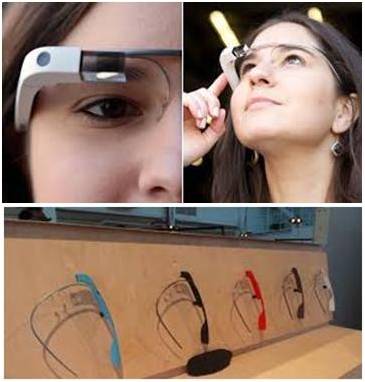
Essentially, Google Glass is a camera, display, touchpad, battery and microphone built into spectacle frames so that you can perch a display in your field of vision, film, take pictures, search and translate on the go.
The principle is one that has been around for years in science fiction, and more recently it’s become a slightly clunky reality. In fact, the “heads-up display” putting data in your field of vision became a reality as early as 1900 when the reflector sight was invented.
Google Glass uses display technology instead to put data in front (or at least, to the upper right) of your vision courtesy of a prism screen. This is designed to be easily seen without obstructing your view. According to Google the display is “the equivalent of a 25-inch high definition screen from eight feet away”. There’s no official word on native resolution, but 640 x 360 has been widely mooted.
Overlaying data into your vision has obvious benefits; many of which are already functional in Google Glass. Directions become more intuitive (although it sounds like there is no GPS on board so you will have to pair it with your phone), you can view real-time translations or transcriptions of what is being said, and you can scroll through and reply to messages – all on the fly.
As well as Google’s own list of features, the early apps for Google Glass provide a neat glimpse into the potential of the headset.
As well as photos and film – which require no explanation – you can use the Google hangout software to video conference with your friends and show them what you’re looking at.
You’ll also be able to use Google Maps to get directions, although with GPS absent from the spec list, you’ll need to tether Glass to your phone.
“Is Glass cool and entirely novel? Yes, it certainly is. Is it a device that will change the life of, or even just prove useful to, the average consumer? That’s doubtful.”
To do that, Google offers the MyGlass app. This pairs your headset with an Android phone. As well as sharing GPS data, this means messages can be received, viewed on the display, and answered using the microphone and Google’s voice-to-text functionality.
Google Glass specifications?
As well as a mooted 640 x 360 display, the built-in camera is a 5MP snapper that can film at 720p.
Battery life is apparently a day, although that’s with the usual “typical use” caveat, which probably excludes a lot of videoing.
There’s 16GB of flash memory built into the device, although only 12GB will be available for user storage. The device will sync to your Google Drive in the cloud
Bluetooth and WiFi will be built in, but no GPS chip – so the Glass will probably work best alongside an Android phone, although you can pair with any Bluetooth enabled phone.
The frame will come with replacement and adjustable nosepads, and is expected to be both lightweight and extremely robust. It will also have a touchpad along one arm.
The sound will be produced through bone conduction transfer – vibrating your skull to transmit to your ears.
There is a Micro USB cable and charger for the dev versions, and all of the above specs are expected to be replicated in the consumer versions when they arrive.
Lastly, Google Glass will come in five colours: Charcoal, Tangerine, Shale, Cotton and Sky. Using Glass’s translation ability to turn that list from marketing speak to plain English, that’s black, orange, grey, white and blue.
Google Glass price?
The Google Glass Explorer (the developer version being sent out now) costs $1,500 – around £985 or AU$1,449.
The consumer versions, which are expected to arrive by the end of 2013, are expected to be a little cheaper, although any actual prices remain speculative. They are unlikely to be super-cheap – but Google’s success with the Nexus 7 tablet may prompt the company to subsidise some of the cost.
Google Glass release date?
A final release date has not been announced, but sources tell us that the original suggestion of 2014 was actually overly pessimistic and we could see Google Glass arrive in time for the end of 2013. So start readying your letter to Santa.